
Ash still clings to framing while damp drywall cools the air, and you’re pushed to act fast without cutting corners. You secure utilities, control access, and stabilize hazards—yet you also triage materials, test residues, and map moisture to prevent hidden failures. You match soot types to cleaners, set negative air, and document every step for compliance and insurance. Move quickly, yes—but only after you’ve answered one critical question that determines what happens next.
Rapid Stabilization: Securing the Scene Without Sacrificing Safety

Before any cleanup begins, you establish control of the site to stop further loss while protecting people and property. You verify utilities are isolated, post a clear scene perimeter, and document conditions. You coordinate with authorities, confirm hot spots are cold, and stabilize entry points. You deploy shoring where structural members are compromised and lay safe egress paths. You implement hazard communication with standardized signage, brief the team on PPE, and log who’s inside. You cover openings to prevent weather intrusion and secure contents at risk. You proceed only when controls are in place, so everyone works fast, together, and safe.
Triage and Scope: Prioritizing What to Save, What to Remove, and What to Test
Once the scene is stable, you shift to triage: a systematic assessment that ranks building elements and contents by salvageability, risk, and value. You map zones, verify utilities are controlled, and document conditions. You apply salvage prioritization to structure, mechanicals, and contents, favoring items with high function, heritage, or replacement lead time. You perform contamination triage: separate porous from nonporous, isolate suspect materials, and flag regulated wastes. You mark remove, stabilize, or test. You order testing for asbestos, lead, and VOCs where disturbance is likely. You align scope with standards, notify stakeholders, and schedule work that protects health and shared goals.
Soot and Smoke Behavior: Matching Residues to the Right Cleaning Methods
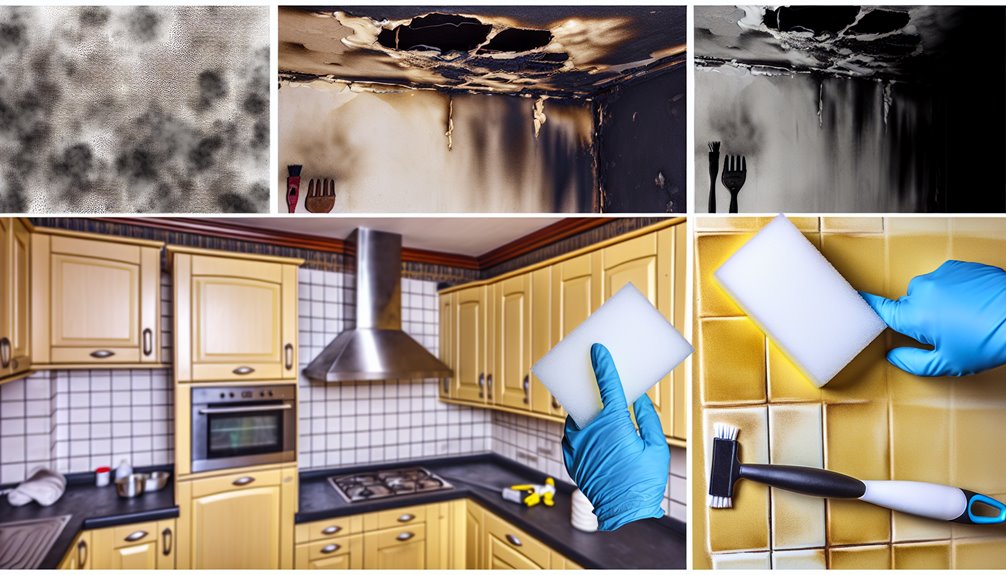
With triage complete and testing queued, you turn to how soot and smoke behaved so you can select safe, effective cleaning methods. You classify residues by fuel and heat: dry, powdery soot from natural materials; oily, protein or synthetic films from Incomplete combustion; and acid-laden, corrosive deposits on metals. You respect Soot chemistry—polar vs nonpolar soils—matching dry vacuuming and HEPA capture before liquids, then pH-appropriate detergents or solvents per IICRC/ANSI guidance. You test small areas, avoid cross-contamination, and change wipes often. You control agitation, dwell time, and rinse quality. You document results and protect occupants and crews with PPE and ventilation.
Moisture Control After Firefighting: Drying Fast to Prevent Hidden Damage
Although the fire is out, the water it took to extinguish it now drives the next phase: rapid, controlled drying to stop secondary damage. You document moisture, set containment, and deploy rapid dehumidification protocols to stabilize materials before mold, swelling, or corrosion takes hold. You track vapor pressures, push vapor drive mitigation, and balance airflow to avoid forcing moisture deeper into assemblies. Calibrated meters confirm progress; you adjust equipment to meet standards and protect occupants and workers.
- Map wet zones with thermal imaging and non-invasive meters
- Establish pressure-controlled containment to guide drying
- Apply targeted heat and dehumidification per material class
- Verify dry goals with daily psychrometric readings
Air Quality Management: Filtration, Ventilation, and Odor Neutralization
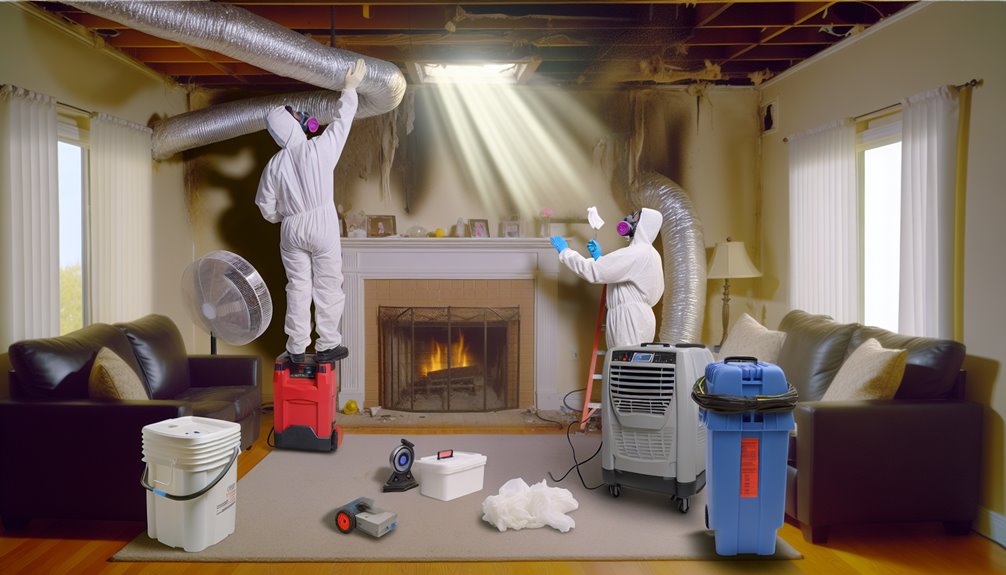
Drying stabilized the structure; now you control what occupants and workers breathe. You establish negative pressure, size air scrubbers to room volume, and replace filters by manometer readings. You deploy HEPA filtration for particulates and activated carbon for VOCs, integrate HVAC filtration only after ducts test clean, and log exchanges per hour. You ventilate from clean to dirty zones, confirm capture with smoke tests, and maintain chain-of-custody for media changes. For odors, you select Ozone free neutralization—enzyme, mineral, or plant-based sorbents—validated by sensory thresholds. You document PPE, clearance sampling, and complaint resolution so everyone feels protected, heard, and welcome.
Structural Assessments: Detecting Heat-Stressed Materials and Concealed Risks
Once air quality controls are stable, you shift to a structured structural assessment that verifies what the fire’s heat, soot, and water actually did to the building. You read heat indicators on framing, fasteners, and connectors, then probe for hidden embrittlement in steel, tempered glass, and concrete. You map deflection, spalling, charring depth, and moisture migration to determine repair limits and safety zones. You document to standards so everyone understands the path forward, together and secure.
- Visual and tactile inspections aligned with NFPA/ICC criteria
- Non-destructive testing to confirm concealed risks
- Moisture and corrosion profiling for affected assemblies
- Load path verification before reloading spaces
Contents Handling: Pack-Out, Inventory, and Specialized Restoration
Start by stabilizing the scene and moving systematically through contents triage: what’s salvageable, what requires specialized treatment, and what’s a total loss under insurer and code criteria. Wear appropriate PPE, isolate clean zones, and prevent cross-contamination. Pack-out room by room, label containers, and document chain of custody. Use artifact cataloging to record condition, provenance, and restoration pathways; photograph before movement. Separate porous, semi-porous, and non-porous items. For fabrics, prioritize textile conservation: neutralize soot, control pH, and dry under tension. Deodorize with approved methods; never mask odors. Store cleaned items in climate-controlled, secured areas. Communicate status transparently so clients feel included.
Toolkits That Speed Accuracy: Meters, Thermal Imaging, and Chemical Test Kits
Although judgment matters, you’ll move faster and document better when you verify with instruments: calibrated moisture meters (pin and pinless) for substrates, hygrometers/thermometers for ambient conditions, and thermal imaging cameras to map hidden moisture and heat anomalies without invasive cuts. You’ll also deploy chemical test kits and handheld spectrometers to confirm soot types, corrosivity, and residue chemistry, guiding agent selection and PPE. Follow calibration protocols before every shift and log reference readings. Work methodically, compare baselines, and retest after each mitigation phase. These tools help you act decisively while keeping the team aligned and safe.
- Cross-verify readings across tools
- Establish dry standards
- Prioritize energized safety checks
- Isolate contaminated zones
Documentation and Compliance: Timelines, Insurance Coordination, and Standards
Before you touch a surface, set your documentation plan to meet standards and insurer requirements. Create a project file, assign roles, and schedule checkpoints tied to regulatory timelines. Capture baseline photos, videos, moisture/soot readings, and chain-of-custody for samples. Log every action with timestamps, locations, and safety approvals. Use standardized forms (IICRC, NFPA) and secure cloud storage with version control.
Prioritize insurer coordination early: confirm coverage scope, deductible impacts, and required photo angles and estimates. Send daily summaries and change orders promptly. Archive permits, MSDS/SDS, and disposal receipts. Keep homeowner and adjuster briefings consistent, respectful, and documented. Your clarity protects everyone and accelerates fair settlements.
Quality Control Checkpoints: Verifying Cleanliness, Dryness, and Safety Before Rebuild
Once demolition and gross cleaning wrap, establish formal checkpoints to prove the structure is clean, dry, and safe for rebuild. You’ll confirm results against standards, document readings, and invite stakeholders to review. This shared rigor builds trust and keeps momentum without compromising safety.
- Verify cleanliness: pass visual/olfactory tests, ATP/soot sampling, and HEPA clearance before sealing cavities.
- Confirm dryness: log calibrated moisture readings, temperature, and GPP; compare to baseline equilibrium.
- Validate safety: test electrical circuits, gas lines, and IAQ; remove hazards; tag compliant zones.
- Complete records: photo logs, chain-of-custody, signatures, and occupant handoff checks, enabling seamless post rebuild verification.
Conclusion
We move fast, but we never skip steps—because your safety and the long-term health of your home matter to me. At Eco Pro Restoration we follow standards like NFPA 921 and IICRC S700/S520 so we don’t rely on speed alone; we triage, test, and document, controlling hazards, identifying residues, validating drying, and checking air quality before any rebuild. I verify dryness, cleanliness, and safety, so you get a restoration that’s not just quick but durable, defensible, and healthier for your family. If you’d like to learn more about our approach or discuss your situation, please visit ecoprorestoration.com or give us a call at (410) 645-0274 — I’m here to help.