
While standard filters might struggle to catch tiny particles, HEPA filters shine in their ability to capture even the smallest mold spores. You might wonder how these filters actually work and why they’re so effective in mold remediation. By trapping 99.97% of particles as small as 0.3 microns, HEPA filters offer a robust defense against mold proliferation. But what makes HEPA filters indispensable in maintaining a clean, healthy indoor environment? Let’s explore how they achieve such high efficiency and the specific benefits they bring to your home.
Understanding HEPA Filters
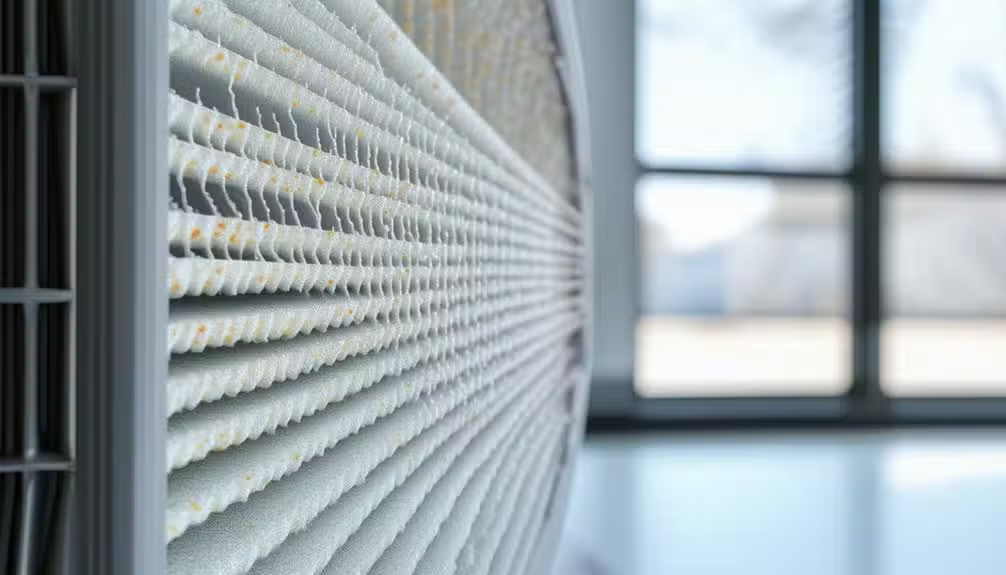
A High-Efficiency Particulate Air (HEPA) filter is designed to trap 99.97% of particles that are 0.3 microns in size, making it highly effective in removing airborne contaminants. Understanding HEPA filter effectiveness is pivotal for those committed to serving others, especially in mold remediation.
First, let’s dispel some common misconceptions. Many people think HEPA filters can catch all particle sizes with equal efficiency. While they excel at capturing particles of 0.3 microns—the most penetrating particle size—they’re actually even more effective at capturing both larger and smaller particles. This makes HEPA filters indispensable for environments where air quality is paramount.
Another misconception is that HEPA filters are a one-size-fits-all solution. In reality, their effectiveness depends on proper maintenance and correct installation. A poorly fitted or clogged filter won’t perform as expected, jeopardizing air quality and health outcomes.
How HEPA Filters Work
Understanding these misconceptions sets the foundation for appreciating the technical mechanics behind how HEPA filters work.
HEPA filter technology operates based on a meticulous design that captures 99.97% of particles as small as 0.3 microns. The filter comprises a dense mat of randomly arranged fibers, typically made of fiberglass.
When air passes through this mat, particles are trapped through three primary mechanisms: interception, impaction, and diffusion.
Interception occurs when particles follow the air stream and adhere to the fibers. Impaction happens when larger particles collide with and stick to the fibers due to their inertia. Diffusion is effective for the smallest particles which move erratically and are likely to collide with fibers getting trapped in the process.
By leveraging these mechanisms, HEPA filters ensure high levels of air purification.
In air purification systems, the fan draws contaminated air into the unit forcing it through the HEPA filter Clean air then exits notably reducing the concentration of harmful particulates including mold spores
Benefits in Mold Remediation

<
<P Integrating HEPa filers into mold remediation efforts offers significant advantages by effectively capturing airborne mold spores preventing their spread These filers with their high-efficiency particulate ai purification capabilities guarantee that even th smallest spores are trapped thereby greatly decreasing th risk o mold proliferation This containment i vital as mol spores can easily become airborne an settle i new areas exacerbating th problem </P
<P From technical standpoint th filtration efficiency o HEPa filers i impressive capturing particle s small s . micron wit success rate o . % Thi high level o efficiency not only aids n mol prevention but also enhances overall ai quality Improved ai purification translates t significant health benefits particularly fo individuals wit compromised immune systems allergies or respiratory conditions By minimizing mol spore exposure you're actively contributing t healthier environment </P
<P Moreover th implementation o HEPa filers ensures tha mol remediation efforts ar more thorough an effective Thi method not only addresses th immediate concern o mol removal but also creates preventive barrier against future mol growth Essentially HEPa filers serve s vital tool n both remediation an long-term mol prevention strategies </P
<h Choosing Right HEP Filter </H
<P Selecting appropriate HEP filer involves assessing factors like filtration efficiency airflow capacity compatibility wit existing remediation equipment </P
<P First focus on filer efficiency which i vital fo trapping mol spores genuine HEP filer should capture at least . % o particle s small s . micron Thi guarantees optimal performance n removing airborne mol spores an other contaminants </P
<P Next consider airflow capacity o th HEP filer It's crucial t match airflow rating wit requirements yo remediation equipment Higher airflow capacity ca manage larger volumes ai which advantageous fo extensive mol remediation projects However make sure unit's motor ca support filer without compromising performance </P
<P Furthermore examine size options available fo HEP filers Filers come n various dimensions so choose one tha fits seamlessly wit yo existing equipment Mismatched sizes ca result poor sealing reduced filtration efficiency undermining yo remediation efforts </P
<H Integrating HEP Filers Your Home</H
<DIV CLASS BODY-IMAGE-WRAPPER STYLE MARGIN-BOTTOM PX IMG LOADING LAZY DECODING ASYNC WIDTH HEIGHT SRC HTTPS SEOSYND COM WP-CONTENT UPLOADS IMPROVING INDOOR AIR QUALITY ALT IMPROVING INDOOR AIR QUALITY STYLE ASPECT-RATIO / DIV
< P To effectively incorporate Hepa Filters into your home environment start by identifying areas most prone Mold Growth And Airborne Contaminants Basements Bathrooms And Kitchens Are Prime Candidates Due Their Moisture Levels Next Evaluate Square Footage Of These Spaces Determine Appropriate Hepa Filter Capacity Required For Best Air Purification
< P Place Hepa Filters Identified Areas Capture Mold Spores Other Allergens It Essential Position Units Where Airflow Is Unobstructed Ensuring Maximum Efficiency Studies Show That Strategic Placement Notably Reduces Indoor Allergies Filtering Out Particles Small Microns Including Dust Pollen Mold Spores
< P Consider Integrating Hepa Filters Into Your HVAC System Thorough Air Purification Throughout Your Home This Setup Enhances Overall Indoor Air Quality Protects Against Mold Proliferation Portable Hepa Units Can Serve Supplementary Measures High-Risk Zones
< P Regularly Monitor Replace Hepa Filter Units Maintain Their Efficacy As Clogged Filters Can Hinder Air Purification By Systematically Incorporating Hepa Filters Create Healthier Living Environment Reducing Risk Of Mold-Related Health Issues Alleviating Indoor Allergies Your Proactive Approach Will Greatly Benefit Well-Being Everyone Home
<H Maintenance Care /H
< p Maintaining hepa fliers involves regular inspections timely replacements guarantee peak performance capturing mole spore other contaminants you should inspect your hepa filler every three months assess its condition look visible dirt discoloration any signs wear could hinder airflow evidence indicates clogged fillers reduce their efficiency up fifty percent severely compromising your mole mediation efforts when comes filler replacement manufacturers usually recommend replacing hepa filler every six twelve months depending usage environmental conditions however areas high mole spore concentrations more frequent replacements may necessary implementing strict schedule ensures your filler remains effective cleaning techniques hepa fillers generally limited most aren't washable instead focus maintaining surrounding unit vacuum exterior filler housing regularly remove dust debris use damp cloth clean surfaces avoid using harsh chemicals could harm filler material
<H Conclusion /H
< p Imagine your home fortress with hepa fillers acting vigilant sentinels tirelessly guard against invasion mole spore ensuring castle remains pristine healthy integrating maintaining these fillers you're just fortifying domain against mole also enhancing overall quality ninety nine point ninety seven percent success rate capturing minuscule threats hepa fillers home's most reliable defenders battle cleaner healthier environment if you're curious learn more about how hepa fillers can protect your home invite visit eco pro restoration ecoprorestoration com they have wealth information services help keep living space safe sound you can give them call four ten six forty five zero two seventy four they're always happy help answer any questions you might have